Friday, April 15, 2011

51 Fantastic Uses for Baking Soda

51 Fantastic Uses for Baking Soda


I don’t mean to sound seditious here, but I have a rebellious plan to combat the ills that many corporations are perpetrating in the name of fighting grime and germs. My main gripe is about the environmental pollutants from cleaning and personal care products that we wash down our drains and into our water systems, resulting in situations like the chemical triclosan (a pesticide added to many products as an antibacterial agent) being found in dolphins.
So the simple plan is to encourage everyone to use baking soda in any of these 51 applications. Besides showing kindness to aquatic life, we can also protect ourselves from the array of toxins in household cleaning products. Conventional cleansers can expose us to multiple chemicals linked to asthma, cancer, and other documented health problems.
Baking soda also makes a perfect stand-in for many personal care products, which are adding their own twist to the toxic tangle of pollutants and personal health (mainly in the form of synthetic fragrance (and it’s almost all synthetic), sodium laurel sulfate, and parabens).
So exactly how does baking soda fit into my scheme to make the world a better place? Baking soda, aka sodium bicarbonate,  helps regulate pH—keeping a substance neither too acidic nor too alkaline. When baking soda comes in contact with either an acidic or an alkaline substance, it’s natural effect is to neutralize that pH. Beyond that, baking soda has the ability to retard further changes in the pH balance, known as buffering. This dual capability of neutralizing and buffering allows baking soda to do things such as neutralize acidic odors (like in the refrigerator) as well as maintain neutral pH (like in your laundry water, which helps boost your detergent’s power). It’s a simple reaction, but one that has far-reaching effects for a number of cleaning and deodorizing tasks. And so without further ado, I’ll remove my scientist cap, put on my rebellious housekeeper’s cap, and get this folk-wisdom revolution rolling…

Tuesday, April 12, 2011

Greening our spring cleaning - AnnArbor.com

O, light of spring! You blindingly beautiful thing. How I've missed you! How I love you! But could you turn it down a bit? You're glaring on all the dirt that winter so kindly covered up. Ohhh, you're gone already.
Yep, it's spring in Michigan, that fickle thing, and already it's gray and cold. But on those few glorious mid-60s days last week, I felt the spring cleaning bug bite.
It'll be back again, along with the sun. And again the dust on the blinds, grease smears on the stove, grime on the outlets and the spots on the windows will be glaringly obvious.
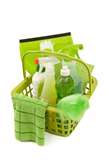
cleaningequip.JPG
In the meantime, I'm ready. I got all my green cleaning ingredients from "Clean House, Clean Planet " by Karen Logan. It's our all-season bible of how to get everything spic and span without hurting ourselves or the earth with harmful chemicals.
Karen's advice basically boils down to all-baking-soda-all-the-time (which makes you wonder: what the heck is baking soda?). Oh, and there's salt, liquid soap, water, elbow grease, the ubiquitous vinegar — and essential oils to cover up the vinegar smell. Lavender-scented kitchen floor, anyone?
The baking soda and salt are the abrasives that don't injure surfaces and do a great job with the grime and soap films. For special problems like mold and stains that need disinfectant, she recommends tea tree oil. Another eco-mom suggests grapefruit seed extract.
All this stuff is readily available across the street at the People's Food Co-op and at other "natural food stores" in our eco-thinking town.

Another great feature of your own green cleaning kit? Less packaging. Reuse your old containers. Mix your clean-green concoctions and fill 'em up. Way, way less waste.
Stuff you find looking up other stuff

  • Another Green Cleaning Kit
  • Treehugger's advice
  • Clorox's "Green Works" cleaners are 99 percent green. Ironically, two of the three ingredients that aren't green are the dyes that turn the "Green Works" liquid the color green.
Linda Lombardini lives as happily green and clean as she can be. You can contact her at Linda@TrilliumRealtors.com.

Friday, April 8, 2011

Disinfecting The Green Way


Store bought disinfectants used in cleaning can contain all sorts of nasty chemicals, some of which should really only be used in controlled settings such as hospitals.

The reason for this is when used around the home inappropriately, these substances can actually help bacteria become resistant to the chemical, creating "superbugs".  Or, diseases resistant to antiboitics.

The heavy duty disinfectant artillery should be left to health professionals as a last line of defense. As has been noted in the case of staph, the excessive and inappropriate use of antibiotics has created super-strains which are now resistant to practically *all* antibiotics.

Some of the chemicals used in commercial preparations can also have a negative effect on aquatic life as water treatment facilities can't filter them out.

A chemical of particular concern is triclosan. Used in everything from bar soaps to toothpaste, it can also be found in some commercial disinfectants. According to Beyond Pesticides, researchers who added triclosan to river water and shined ultra violet light on the water found that between one and twelve percent of the triclosan was converted to dioxins. Dioxins are incredibly toxic to aquatic organisms, animals and humans and as these substances are bioaccumulative, they work their way up the food chain.

In a U.S. Geological Survey study of 95 different organic wastewater contaminants in U.S. streams, triclosan was one of the most frequently detected compounds.

This is a serious environmental issue that we can all play a role in helping to address - for starters, taking more care in the types of disinfectant we choose and use.


Greener disinfecting alternatives

It's important to bear in mind that disinfecting something means killing something else; that the nature of the process is destructive - however, the goal is to minimize "collateral damage".

While there are quite a few environmentally friendly (or should I say, friendlier) products on the market, making your own environmentally friendly disinfectant is very cheap and extremely quick to do using just eucalyptus oil and water.

Simply mix 1.6 oz (around 50 ml) of eucalyptus oil with a quart (litre) of water. That's all there is to it - not everything that is effective needs to be complex.

Be sure to shake well before use and use as you would a store bought disinfectant. Also keep the mixture out of direct sunlight in a opaque container.

Not only will you have a greener disinfectant, but by making your own, you're more likely to use the same container, therefore cutting down your plastic consumption.

Eucalyptus oil is amazing stuff and you'll see it mentioned regularly throughout this site. I've read that European doctors used to use eucalyptus oil to disinfect and sterilize their equipment. Do be careful when handling eucalyptus oil as it's quite potent and can cause skin irritation in its undiluted form.

Here's another disinfectant recipe if you're not particularly fond of the smell of eucalyptus:

Grapefruit Seed Extract Disinfectant Spray

Ingredients:

1 gallon warm water
20 drops grapefruit seed extract
Mix and pour in a spray bottle


Courtesy of:
Green Living Tips.comGreen Living Tips is an online resource powered by renewable energy offering a wide variety of earth friendly tips, green guides, advice and environment related news to help consumers and business reduce costs, consumption and environmental impact .

Thursday, April 7, 2011

Great Pacific Garbage Patch

We all know about this....but sometimes the magnitude of something on the order of what we have going on here is just too much to wrap our minds around.

Also known as the Trash Vortex and a variety of other names, the Great Pacific Garbage Patch exists in the North Pacific Gyre, a clockwise swirl of currents that's home to little except phytoplankton - and trash. Lots of trash. So much trash that for every pound of plankton, it's estimated there's 6 pounds of plastic garbage.


A Glimpse of the Tragedy from Midway on Vimeo.

Occasionally, ocean currents will change and release some of cache of garbage, which winds washing up on the beaches around the outskirts of the gyre in huge amounts. Ocean researcher Charles Moore reported the amount of plastics in areas of the gyre to be somewhere around 3.3 million pieces per square kilometer!
It is estimated that over 20 billion pounds of plastic ends up in the ocean - each year. Plastics are particularly nasty in an aquatic environment; aside from being toxic, they don't biodegrade, but just break into increasingly smaller pieces that are dispersed widely. These particles can clog the gills of fish and filter feeders.
Also, aquatic birds tend to be attracted to the plastic and ingest quantities that can block their digestive tract - they literally starve to death. Turtles are particularly prone to eating plastic bags and fishing line, especially those species that dine on jellyfish.
The ocean is big; our planet is big - but it just goes to show, it's not big enough to cope with our modern garbage. We really need to avoid plastics wherever we can - and recycle what we can't seem to avoid; there's simply no safe place to dump these items.

Monday, April 4, 2011

A Letter From Japan

Here is a letter from a friend of a friend, an older woman who has been living in Japan and teaching English for the past 10 years.


Hello My Lovely Family and Friends,

First I want to thank you so very much for your concern for me. I am very touched. I also wish to apologize for a generic message to you all. But it seems the best way at the moment to get my message to you.

Things here in Sendai have been rather surreal. But I am very blessed to have wonderful friends who are helping me a lot. Since my shack is even more worthy of that name, I am now staying at a friend's home. We share supplies like water, food and a kerosene heater. We sleep
lined up in one room, eat by candlelight, share stories. It is warm, friendly, and beautiful.

During the day we help each other clean up the mess in our homes. People sit in their cars, looking at news on their navigation screens, or line up to get drinking water when a source is open. If someone has water running in their home, they put out a sign so people can come to fill up their jugs and buckets.

Utterly amazingly that where I am there has been no looting, no pushing in lines. People leave their front door open, as it is safer when an earthquake strikes. People keep saying, "Oh, this is how it used to be in the old days when everyone helped one another."

Quakes keep coming. Last night they struck about every 15 minutes. Sirens are constant and helicopters pass overhead often. We got water for a few hours in our homes last night, and now it is for half a day. Electricity came on this afternoon. Gas has not yet come on. But all of this is by area. Some people have these things, others do not.

No one has washed for many days. We feel grubby, but there are much more important concerns than that for us now. I love this peeling away of non-essentials. Living fully on the level of instinct, of intuition, of caring, of what is needed for survival, not just for me, but of the entire group.

There are strange parallel universes happening. Houses a mess in some places, yet then a house with futons or laundry out drying in the sun. People lining up for water and food, and yet a few people out walking their dogs. All happening at the same time.

Other unexpected touches of beauty are first, the silence at night. No cars. No one out on the streets. And the heavens at night are scattered with stars. I usually can see about two, but now the whole sky is filled. The mountains of Sendai are solid and with the crisp air, we can see them silhouetted against the sky magnificently.

And the Japanese themselves are so wonderful. I come back to my shack to check on it each day, now to send this e-mail since the electricity is on, and I find food and water left in my entranceway. I have no idea from whom, but it is there. Old men in green hats go from door to door checking to see if everyone is OK. People talk to complete strangers asking if they need help. I see no signs of fear. Resignation, yes, but fear or panic, no.

They tell us we can expect aftershocks, and even other major quakes, for another month or more. And we are getting constant tremors, rolls, shaking, rumbling. I am blessed in that I live in a part of Sendai that is a bit elevated, a bit more solid than other parts. So, so far this area is better off than others. Last night my friend's husband came in from the country, bringing food and water. Blessed again.

Somehow at this time I realize from direct experience that there is indeed an enormous Cosmic evolutionary step that is occurring all over the world right at this moment. And somehow as I experience the events happening now in Japan, I can feel my heart opening very wide.
My brother asked me if I felt very small because of all that is happening. I don't. Rather, I feel a part of something happening that's much larger than myself. This wave of birthing (worldwide) is
hard, and yet magnificent.

Thank you again for your care and Love of me,

With Love in return, to you all,

Anne


Rev. Katherine Q. Revoir

Friday, April 1, 2011

"Who" Is Slow Food?

What you put into your mouth goes into your body.  Everywhere in you body.  I am not being sarcastic but pointing out the obvious that we should all think about when we peel off that plastic wrapper imprinted with unpronounceable words and shove it into our mouths without looking at it.


"Slow food" is a direct counter balance to the fast-food culture. Instead of eating fries while driving one-handed through traffic, it means taking the time to enjoy good food raised in clean, safe conditions and sold at a fair profit for the farmer. It means taking the time to know the food you eat is healthy - for you, for the people who produce it, and for the land. According to USA Today, SlowFood "claims to be everything that fast food is not."

SlowFood is an idea, a way of living and a way of eating. It is a global, grassroots movement with thousands of members around the world that links the pleasure of food with a commitment to community and the environment.


Just 30 plants feed 95 percent of the world's 6.5 billion people, according to Slow Food, which is encouraging a global effort to broaden that diversity.

Many foods we love (specific grains, vegetables, fruits, animal breeds) are disappearing due to the overwhelming amount of convenience food and industrial agriculture. What's grown by industrial agribusiness is based on what's hardy, easiest to grow, and easiest to ship across the continent - not necessarily taking taste, health and variety into account.  Like the proposed square banana or genetically engineered or modified food. 
 
Some people are tired of the degraded flavor of our foods and of health issues raised by an industrialized food supply, so they find the "slow food" message appealing. Preserving our resources, tradition and culture ensures that food is produced for taste and variety. This is ultimately what makes food enjoyable.

The Daily Green embraces the Slow Food manifesto that promotes taking the time to teach and share the rewards of raising and eating food that is good, clean and fair.

To read the first chapter of Michael Pollan's book, "The Omnivore's Dilemma," which explains where food comes from, check out: www.michaelpollan.com.

In researching this post, I found the following links to be excellent reads:

http://www.slowfoodusa.org/index.php/slow_food/blog/

http://michaelpollan.com/todays-link/


http://green.blogs.nytimes.com


http://civileats.com/